On the Polish residential market there's a whole category of projects no one wants to talk about out loud: investments that started and then stopped. Sometimes for a quarter, sometimes for two years. The board still stands, the banner fades, the foundations wait. The industry calls them different things — ghost projects, gridlocks, dead phases. Buyers call them something simpler: risk.
Restarting such an investment is one of the things I do — alongside positioning and go-to-market for projects that launch cleanly. I'll describe the method in full, because the method is the value here. I don't describe specific projects: in this line of work discretion toward the client is part of the product, and a developer who sees that I can keep quiet about someone else's data knows I'll keep quiet about his too.
This isn't a story about "refreshing the logo". It's a method for how you rebuild the market credibility of a project that has lost it.
Why investments stall — and why that isn't always a failure
The market's first reflex when construction stops is brutal and unambiguous: the developer has a problem. The buyer doesn't analyse the causes. They see a pause and run, because on a market where you pay hundreds of thousands of zlotys into a hole in the ground, a pause is a signal of risk.
The problem is that the causes vary. Some stalls are real trouble — financing, disputes, mistakes. But some are rational decisions that look identical from the outside. An investment waiting for the site to be serviced — for utility connections to be approved, say — is not a project in trouble. It's a project that doesn't want to sell homes without infrastructure. From the buyer's perspective it's the same fading board. From a risk perspective it's two completely different situations.
The first job in a restart isn't marketing. It's distinguishing which situation the project is really in — and whether that can be proven.
A restart starts with an audit, not with creative
The most common mistake when relaunching a stalled investment: the developer (or their agency) starts with a new logo and pretty renders. That's treating the symptom. The old narrative hasn't disappeared — it's still hanging in Google, in old listings, in the local market's memory.
The order I use is the reverse:
- Footprint audit — what the internet says about the project today. Old listings under the old name, reviews, forums, photos from the period when construction stood still. You can't erase that with creative. You have to inventory it before you build anything anew.
- Hard fact verification — what can be proven. Permit status, utility-acceptance dates, work progress, product parameters. Everything that becomes the foundation of the new communication has to be verifiable. Not "premium". Not "dream". Verifiable.
- Product diagnosis — whether what the developer is selling actually differs from the competition in a measurable way, or only in the description. This is usually the moment you find the real advantage — or its absence.
Only after these three steps does it make sense to talk about the brand.
New positioning: facts instead of promises
An investment that has lost trust won't win it back with aspirational language. "Enclave", "prestige", "slow-life" — words that on a healthy project are merely empty, and on a project that's been through trouble sound like a smokescreen. The more adjectives, the less belief.
The strategy I build goes the opposite way: radical transparency. Communication based solely on facts that can be verified. Instead of promising emotion — show the document. Instead of painting a lifestyle — show what's actually being built.
This positioning is harder to execute, because it requires the project to actually have something to show. But it's the only one that works on a market where the buyer has already seen the pause once and learned not to trust words.
Part of this work is also naming the past honestly. Trying to hide that construction stalled is worse than the stall itself — because the buyer will find it anyway. Better to say outright why the project waited and show what has changed. A pause explained by a fact stops being a signal of risk. A pause kept quiet remains one forever.
Recognise this in your own numbers?
Book a callWhy I drop renders in favour of photos and video
Here we reach the heart of the restart and the most important decision in all the materials.
A render is a promise. It shows how it will be. On a project that is only just regaining trust, a render is exactly what the buyer didn't get once already — a vision that didn't come true. Showing pretty visualisations of an investment that stalled repeats the very mechanism that built the mistrust.
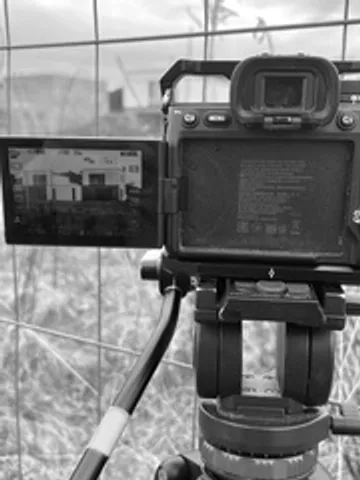
A photo and a film from the site are proof. They show how it is. Real foundations, real walls, real progress over time. That shifts the whole weight of the communication from "trust us" to "see for yourself".
That's why I build such an investment's materials on documentary photography and video from the construction site — not on renders. Not because renders are ugly. Because on a project after a stall a render says "we promise", and a photo says "we're doing it". And the only thing that rebuilds trust is proof that the work is happening.
That's the whole philosophy of this rebranding in one sentence: we stop promising, we start showing.
What this kind of project teaches
Restarting a stalled investment is not a marketing problem. It's a trust problem that only looks like a marketing one. Logo, colours, the website — those are tools. But if underneath there are no facts you can show, the best branding only wraps the same risk more nicely.
The best brand a project that's been through trouble can have is proof. The rest is just a way to make that proof visible.
I work on go-to-market strategy, positioning and sales materials for residential developers — from projects launching cleanly to restarts of investments after a pause. This text describes a method, not a specific client.